
The S-Line Is Coming to Wake Forest: What a High-Speed Rail Connection to Downtown Raleigh Means for Your Property Value
By Phillip Johnson | The Phillip Johnson Group, eXp Luxury
---
There's a quiet revolution rolling toward Wake Forest, and most homeowners haven't fully connected the dots on what it means for their equity.
Raleigh has secured over $1.1 billion in federal and state funding for the S-Line rail project - specifically the segment that will link downtown Raleigh directly to Wake Forest. This isn't a study, a proposal, or a "maybe someday" line on a planning map. Grade separation work has already broken ground, and the Town of Wake Forest has already named its preferred site for a future rail station.
As someone who has spent nearly three decades helping Triangle families buy and sell - and who came up through the general contracting world before that - I can tell you: real estate moves ahead of infrastructure, not after it. The window to position yourself is now, not in 2031 when the ribbon gets cut.
Here's everything you need to know.
---
🚆 What Is the S-Line, Exactly?
The S-Line is a freight rail corridor - and former passenger line - owned by CSX that historically connected Richmond, Virginia to Tampa, Florida. North Carolina and Virginia are now purchasing a portion of that right-of-way from Raleigh to Petersburg, VA, and refurbishing it for modern passenger rail service.
For Wake Forest, the headline is simple: completion of this project directly links our town to the nation's passenger rail network for the first time in generations.
A few facts that matter:
🚄 Speeds up to 110 mph - this is genuine higher-speed rail, not a slow commuter shuttle
⏱️ Downtown Raleigh to Wake Forest in under 20–30 minutes** by rail
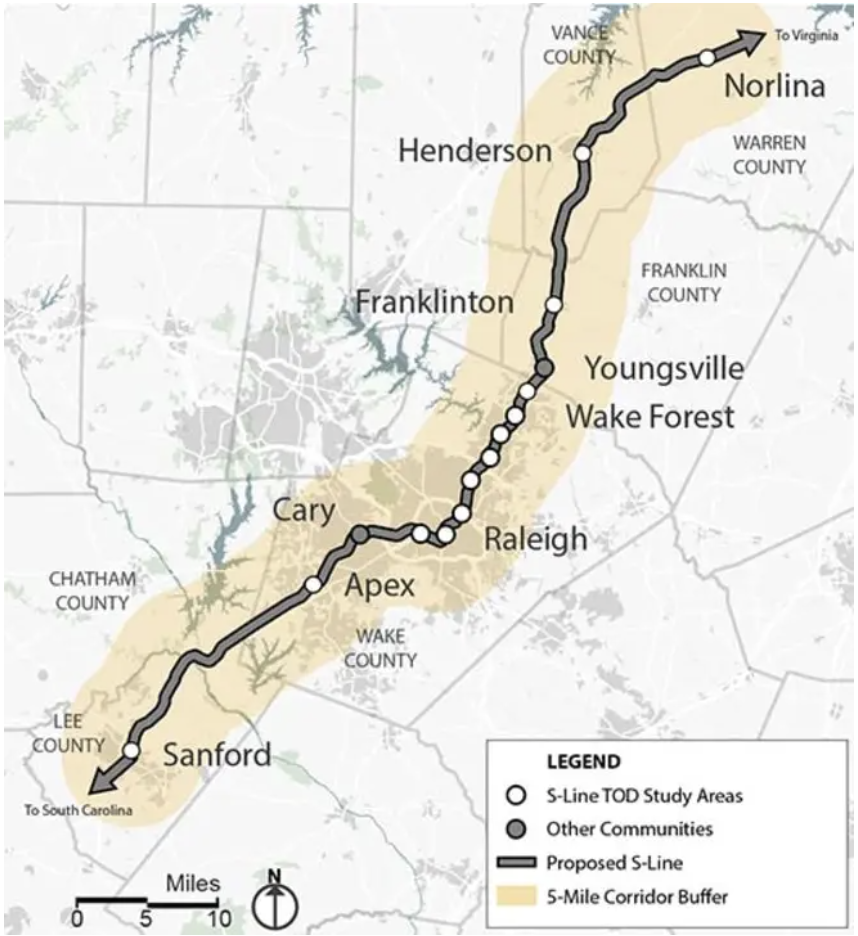
🏙️ Long-term vision connects Raleigh → Richmond → Washington, D.C., with future Triangle-area stops in Youngsville, Franklinton, Henderson, and Norlina
🗓️ More than 20 years in the making** - community engagement launched in the early 2000s
NCDOT's Integrated Mobility Division is leading transit-oriented development planning for seven communities along a 95-mile section of the corridor. Wake Forest is one of them.
---
📍 The Route & Timeline: Where Things Actually Stand
This is the part every homeowner should paste on the refrigerator. The project is real and it's already underway:
| Milestone | Status |
| Grade separation work (Durant Rd & New Hope Church Rd, Raleigh) | ✅ Began in 2024
| Wake Forest mobility hub planning phase | 🔄 Scheduled through December 2025 |
| Construction on the Wake Forest segment | 🔨 Projected to begin in 2027 |
| Rail service opens | 🎯 Targeted for 2030–2032 |
The train will pull in from North Raleigh, run alongside Atlantic Avenue and Wake Forest Road, cross over Capital Boulevard, and travel down West Street on the final stretch into Raleigh Union Station. Because high-speed passenger rail requires improved tracks, a larger buffer than slow freight, and new bridges and underpasses at multiple crossings, the corridor footprint will expand beyond the current tracks.
---
🏡 Downtown Wake Forest Was Chosen for the Mobility Hub
Here's a detail that should get every Wake Forest property owner's attention: Downtown Wake Forest was selected as the preferred site for a future S-Line mobility hub - including an Amtrak rail station.
A mobility hub is more than a train platform. It's a connectivity center designed around transit that can include:
- 🚉 Rail platforms
- 🚲 Bicycle and scooter rental
- 🚌 Bus stops and shelters
- 🔌 Electric vehicle charging
- 🌳 A mini park or plaza waiting area
- 🚗 Ride-hail services (Uber, Lyft, Via)
Put simply: the town is planning for downtown Wake Forest to become a walkable, connected transit anchor. That is exactly the kind of designation that reshapes a local market.
💰 What Rail Does to Real Estate Values
Let's talk about the part that hits your net worth.
The S-Line is being built around a transit-oriented development (TOD) strategy. TOD creates compact, mixed-use, walkable communities near transit - housing, retail, office space, and civic amenities clustered within walking distance of the hub. These areas consistently outperform surrounding neighborhoods on demand and appreciation, because accessibility and concentrated amenities are exactly what today's buyers pay a premium for.
If you want a preview of what's coming, look at what happened to property values near the stations on Charlotte's LYNX Blue Line.Rail changes the equation.
And Wake Forest starts from an already-strong position. We're growing fast, and a direct rail connection to downtown Raleigh rewrites the math for every buyer who previously crossed us off the list over the commute. Consider the equation from a buyer's seat:
A 25–30 minute rail ride to downtown Raleigh + home prices meaningfully below inside-the-beltline = one of the most compelling value plays in the entire Triangle.
That's not hype. That's supply, demand, and geography.
---
🎯 What This Means for You Right Now
The line doesn't open until 2030 at the earliest. So why does it matter today? Because the buyers and owners who position before the station areas are fully developed are the ones who capture the appreciation - not the ones who wait for the ribbon-cutting.
Here's how I'm advising clients depending on where they sit:
🔑 If You're a Buyer
This is a rare "get in early" moment. Properties within a **half-mile to one mile of the planned downtown Wake Forest station** stand to see the most direct impact. Buying in north Wake County now - before TOD zoning and station-area development are locked in - is the classic pre-infrastructure equity play that has rewarded early movers in growing cities across the country.
🏷️ If You're a Seller
Your Wake Forest property is sitting on a value catalyst that many buyers don't fully understand yet. The right marketing tells that story. When I list a home near this corridor, the S-Line isn't a footnote - it's a headline. Positioning your home within the future transit narrative can meaningfully sharpen buyer urgency.
📈 If You're an Investor
Watch for TOD announcements from the Town of Wake Forest, keep an eye on mixed-use and walkable zoning discussions around the station, and target the half-mile-to-one-mile ring. This is a multi-year appreciation runway with a defined catalyst and a public timeline — the kind of setup investors rarely get with this much visibility.
⚠️ If You Own Property Directly on the Corridor
Be aware: NC railroad right-of-way can range anywhere from 30 to 200+ feet from the centerline, and until the final railway design is set, exactly how much space the S-Line will claim isn't fully known. Some properties along the existing corridor have already been flagged as potentially affected by infrastructure improvements. If your property sits on or near the route, understanding your rights and the potential impact is worth a direct conversation.
---
🧭 The Bottom Line from The Phillip Johnson Group
I've watched the Triangle transform for nearly 28 years. Infrastructure of this scale doesn't come along often, and when it does, it redraws the map of where people want to live and what they'll pay to live there.
The S-Line won't just fill a missing transit link for Wake Forest - it plugs our town into a Southeast rail corridor that eventually reaches Washington, D.C. It gives people the ability to live where they want to live and work where they want to work, and history says the neighborhoods within walking distance of the station will be the biggest winners.
The homeowners who understand this early are the ones who'll be glad they did.
---
📞 Let's Talk About Your Position on the Map
Whether you're thinking about buying near the future station, wondering how the S-Line affects your home's value, or weighing an investment along the corridor, I'd welcome the conversation. This is exactly the kind of local, on-the-ground market intelligence my clients count on.
Phillip Johnson
The Phillip Johnson Group | eXp Luxury
Serving Wake Forest, Raleigh & the Greater Triangle
Licensed NC Realtor • ~28 years of Triangle real estate experience • General contractor background*
Check out this article next