Capital Boulevard Upgrade: What Raleigh & Wake Forest Residents Need to Know
Capital Boulevard Is About to Look Very Different
If you live in North Raleigh, Wake Forest, Rolesville, Youngsville, or anywhere along the U.S. 1 corridor, one of the Triangle's most significant transportation projects deserves your attention.
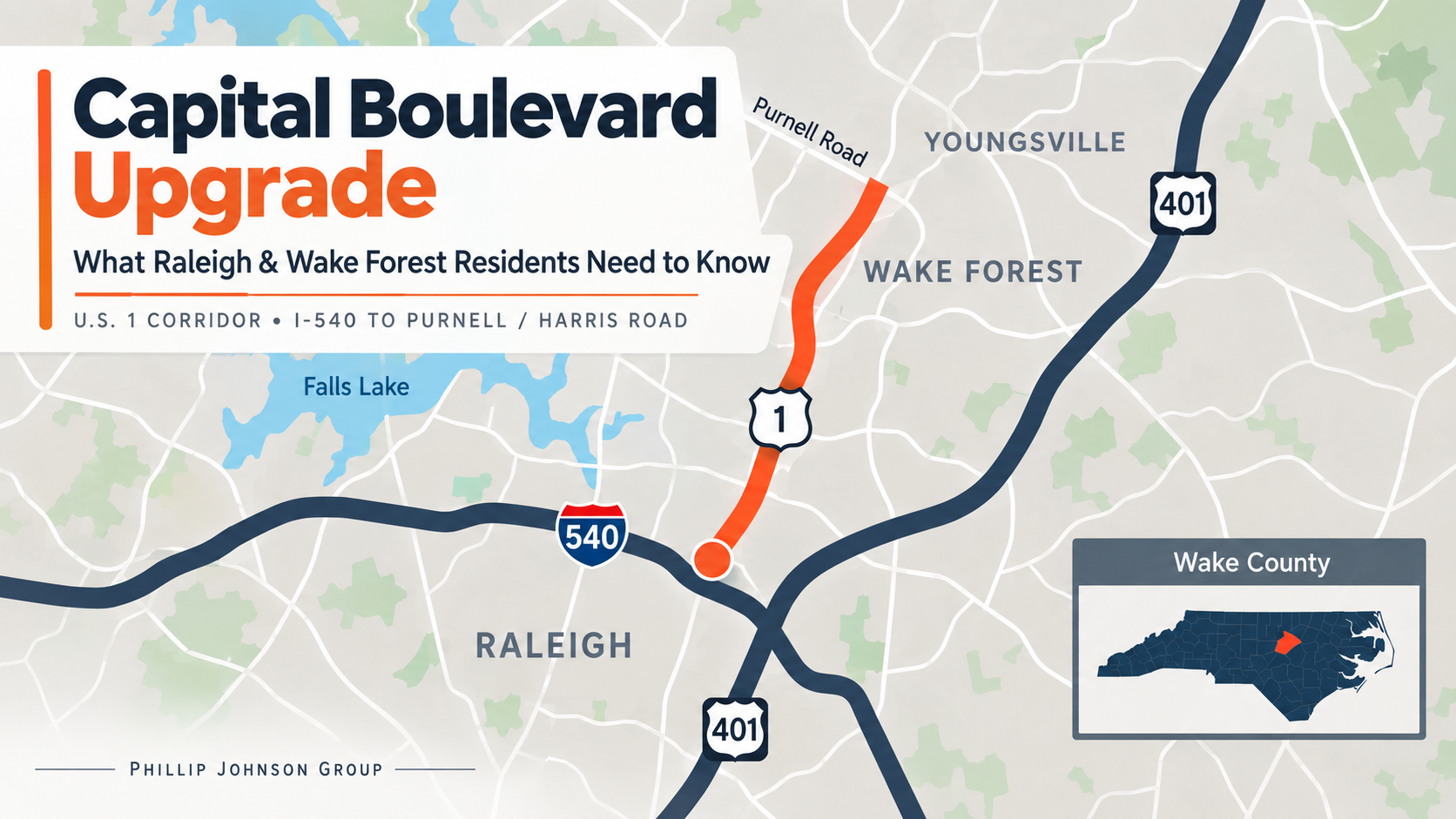
The North Carolina Department of Transportation is moving forward with the Capital Boulevard North Upgrade, a major reconstruction of U.S. 1 between I-540 in Raleigh and Purnell Road/Harris Road in Wake Forest.
This isn't simply a widening project.
NCDOT plans to transform this stretch of Capital Boulevard from today's four-lane, divided roadway with traffic lights, driveways and numerous access points into a six-lane, controlled-access highway with interchanges. (NCDOT)
Think of it as Capital Boulevard becoming much more like a freeway.
For people who travel between Raleigh and Wake Forest every day—and for property owners, buyers, sellers and businesses along the corridor—that is a major change.
What Exactly Is NCDOT Planning?
Today, Capital Boulevard includes a mixture of traffic signals, businesses with direct driveway access, side streets and major intersections.
Under the proposed design, traffic signals within the project limits would be removed, and motorists would enter and exit U.S. 1 primarily through ramps and interchanges. Direct driveway access to Capital Boulevard would also be removed, while service roads and connecting streets would be used to maintain local access. (NCDOT)
The project currently includes:
Expanding Capital Boulevard to six lanes
Removing traffic signals within the project area
Eliminating direct driveway connections to U.S. 1
Adding service and connector roads
Constructing new interchanges
Improving several existing interchanges
Building new overpasses
One especially important point: this is currently planned as a non-tolled highway.
A possible toll-road approach was studied from January 2024 through November 2025, but that evaluation ended. The project is now proceeding as a traditional, non-tolled roadway. (NCDOT)
That answers one of the questions I hear most often when people discuss the future of Capital Boulevard.
Where Will the New Interchanges Be?
The interchange plan is particularly important for anyone considering where to live, buy property or operate a business along the corridor.
NCDOT currently plans new interchanges at:
Durant Road / Perry Creek Road
This is a major connection for North Raleigh neighborhoods and communities east and west of Capital Boulevard.
Burlington Mills Road
An increasingly important connection between Raleigh and Wake Forest and a major access point for residential communities surrounding the corridor.
Falls of Neuse Road / South Main Street / U.S. 1A
This could become one of the most important gateways into Wake Forest.
Purnell Road / Harris Road
This interchange serves the rapidly growing northern Wake Forest area and provides connections toward Youngsville and Franklin County.
NCDOT also plans improvements to the existing interchanges at I-540, N.C. 98 Bypass and N.C. 98 Business/Durham Road. (NCDOT)
Two More Intersections Will Become Overpasses
Two locations are currently planned to become overpasses rather than traditional intersections:
Gresham Lake Road, north of I-540, and Jenkins Road/Stadium Drive in Wake Forest.
Rather than stopping Capital Boulevard traffic at these locations, local traffic would cross above or below U.S. 1 while through traffic continues along the highway. (NCDOT)
That illustrates the fundamental idea behind this entire project: separate local traffic from through traffic whenever possible.
The Project Has Been Divided Into Four Sections
Because this is such a large undertaking, NCDOT has divided the Capital Boulevard project into four segments.
| Segment | Location |
|---|---|
| A | I-540 to Durant/Perry Creek roads |
| B | Durant/Perry Creek roads to Burlington Mills Road |
| C | Burlington Mills Road to N.C. 98 Business/Durham Road |
| D | N.C. 98 Business/Durham Road to Purnell/Harris roads |
Segments A and B are currently in final design, with right-of-way acquisition activities underway. Segments C and D are expected to restart final-design work in late/winter 2026. (NCDOT)
That distinction is important because different portions of the corridor will move forward on different schedules.
When Will Construction Actually Begin?
Don't expect bulldozers along the entire corridor next year.
This is a long-term infrastructure project involving engineering, right-of-way acquisition, utility relocation and construction.
As of the latest NCDOT schedule:
Segments A & B
Right-of-way acquisition began in September 2025, with construction currently scheduled to begin in 2031.
Segments C & D
Right-of-way acquisition is scheduled to begin in fall 2027, with construction currently scheduled to begin in 2033.
NCDOT emphasizes that these future dates are subject to change. (NCDOT)
One reason for the extended timeline is the complexity of relocating utilities. NCDOT says 15 utility providers are located within the project corridor, making coordination and relocation a substantial undertaking. (NCDOT)
Work Is Already Happening
Although major highway construction remains several years away, the project is not simply sitting on a drawing board.
NCDOT began geotechnical work in June 2026, studying soil, rock and groundwater conditions that engineers need when designing roads, pavement, bridges and other structures. (NCDOT)
Fieldwork has also included surveys, utility locations, septic evaluations and site-specific studies.
For residents, that means seeing survey crews or other activity near Capital Boulevard does not necessarily mean road construction is about to begin. Much of the work occurring now supports engineering and final design.
What Does This Mean for Property Owners Along Capital Boulevard?
This may be the most important part of the project for some homeowners and commercial property owners.
NCDOT began right-of-way acquisition for Segments A and B in September 2025. The agency expects the overall acquisition process for those sections to take approximately four to five years.
NCDOT says affected property owners will be contacted individually by NCDOT representatives or authorized agents. Because the process is being phased, it may be several years before some affected owners are contacted. (NCDOT)
If you own property directly along Capital Boulevard—or near one of the proposed interchanges or service roads—I would recommend looking at the NCDOT maps rather than relying on general descriptions of the project.
A house or commercial property only a short distance away can be affected very differently depending upon the final roadway configuration.
View NCDOT's Capital Boulevard North Upgrade project page
What Could the Upgrade Mean for Wake Forest and North Raleigh?
From a real-estate perspective, transportation projects this significant are worth watching long before construction begins.
The project's stated purpose is to improve congestion and travel times along the Raleigh-to-Wake Forest corridor. (NCDOT)
But individual properties can experience different effects.
A homeowner several miles from Capital Boulevard may primarily care about commuting and regional accessibility. A property immediately beside the corridor may need to consider noise, road configuration, right-of-way or changes in neighborhood access. A commercial property could face a very different question: How will customers reach the property after direct U.S. 1 driveway access is eliminated?
That is why I wouldn't make a blanket statement that the project will automatically increase or decrease the value of a particular property.
Location within the project matters.
Wake Forest's Growth Makes Transportation Increasingly Important
For decades, Wake Forest felt distinctly separated from Raleigh.
That line has become increasingly difficult to see.
Residential development now stretches through North Raleigh, Wakefield, Falls River, Wake Forest and into communities farther north toward Youngsville and Franklin County. At the same time, employment, shopping, restaurants and entertainment increasingly connect residents throughout the Triangle.
Capital Boulevard is one of the primary north-south transportation corridors tying those areas together.
Transforming U.S. 1 into a controlled-access highway could therefore influence how people think about commuting and accessibility throughout this part of Wake County.
And the project doesn't affect only people living directly beside U.S. 1. Residents who regularly use Falls of Neuse Road, Burlington Mills Road, N.C. 98, South Main Street, Durant Road, Perry Creek Road, Purnell Road or Harris Road should be following the project as well.
Buying a Home Near the Capital Boulevard Corridor?
When I'm helping someone evaluate property in North Raleigh, Wake Forest, Rolesville, Youngsville and surrounding communities, I believe future infrastructure should be part of the conversation.
That doesn't mean avoiding an area simply because a road project is planned.
It means understanding what you're buying.
For example:
Where will the nearest future interchange be?
A neighborhood's access to U.S. 1 could look very different after the project is completed.
Will today's intersection remain?
Some intersections will become interchanges, some will become overpasses and direct access to Capital Boulevard will disappear.
Is the property near proposed right-of-way?
Check the actual NCDOT project maps rather than assuming based on distance.
How could a service road affect access?
Service roads will become important because properties will no longer connect directly to Capital Boulevard.
These are exactly the types of hyperlocal details that can matter when comparing two otherwise similar properties.
Selling a Home Near Capital Boulevard?
Sellers should also understand the project before putting their home on the market.
Buyers are increasingly researching transportation projects before making offers, and some may arrive with questions about Capital Boulevard.
Being able to explain the project accurately is much better than saying, "I heard they're widening the road."
The full story is considerably bigger.
Capital Boulevard is planned to become a six-lane controlled-access corridor, with major new interchanges, service roads and substantially different access throughout the Raleigh-to-Wake Forest corridor.
Understanding where your property sits in relation to those improvements can help put the project in the proper context for buyers.
One Project I'll Be Following Closely
This is going to be a story worth following for years.
As someone who works throughout Raleigh, North Raleigh, Wake Forest, Rolesville, Youngsville and the surrounding Triangle communities, I'll continue watching the Capital Boulevard project as designs become more detailed and NCDOT releases additional information.
Infrastructure may not be the first thing people think about when buying real estate, but over time, roads, interchanges, greenways, schools, commercial development and access to employment centers help shape how communities grow.
And few transportation projects have the potential to change the North Raleigh-to-Wake Forest corridor as significantly as this one.
Thinking About Buying or Selling in the Raleigh–Wake Forest Area?
If you're considering a move and want to understand not only the house but also what's happening around it, that's where local market knowledge becomes especially valuable.
The Phillip Johnson Group – eXp Realty helps buyers and sellers throughout Raleigh, North Raleigh, Wake Forest, Rolesville, Youngsville and surrounding Triangle communities understand neighborhoods, new construction, planned development and the infrastructure projects that can affect them.
Contact the Phillip Johnson Group to talk about your next move—or about how projects such as the Capital Boulevard upgrade could relate to a property you're considering.
Project information and timelines in this article are based on NCDOT information available as of September 2026. Transportation designs, right-of-way requirements, funding and construction schedules can change. Property owners should consult NCDOT directly regarding specific right-of-way or project-impact questions. (NCDOT)
Check out this article next